How To Implement Download Button Html5 External Image
Blobs and object URLs exposed
File downloading is a core aspect of surfing the net. Tons of files get downloaded from the internet every day ranging frombinary files (like applications, images, videos, and audios) to files in plainly text.
Fetching files from the server
Traditionally, the file to be downloaded is first requested from aserver through acustomer — such as a user'due south web browser. The server then returns a response containing thecontent of the file and some instructional headers specifying how the client should download the file.
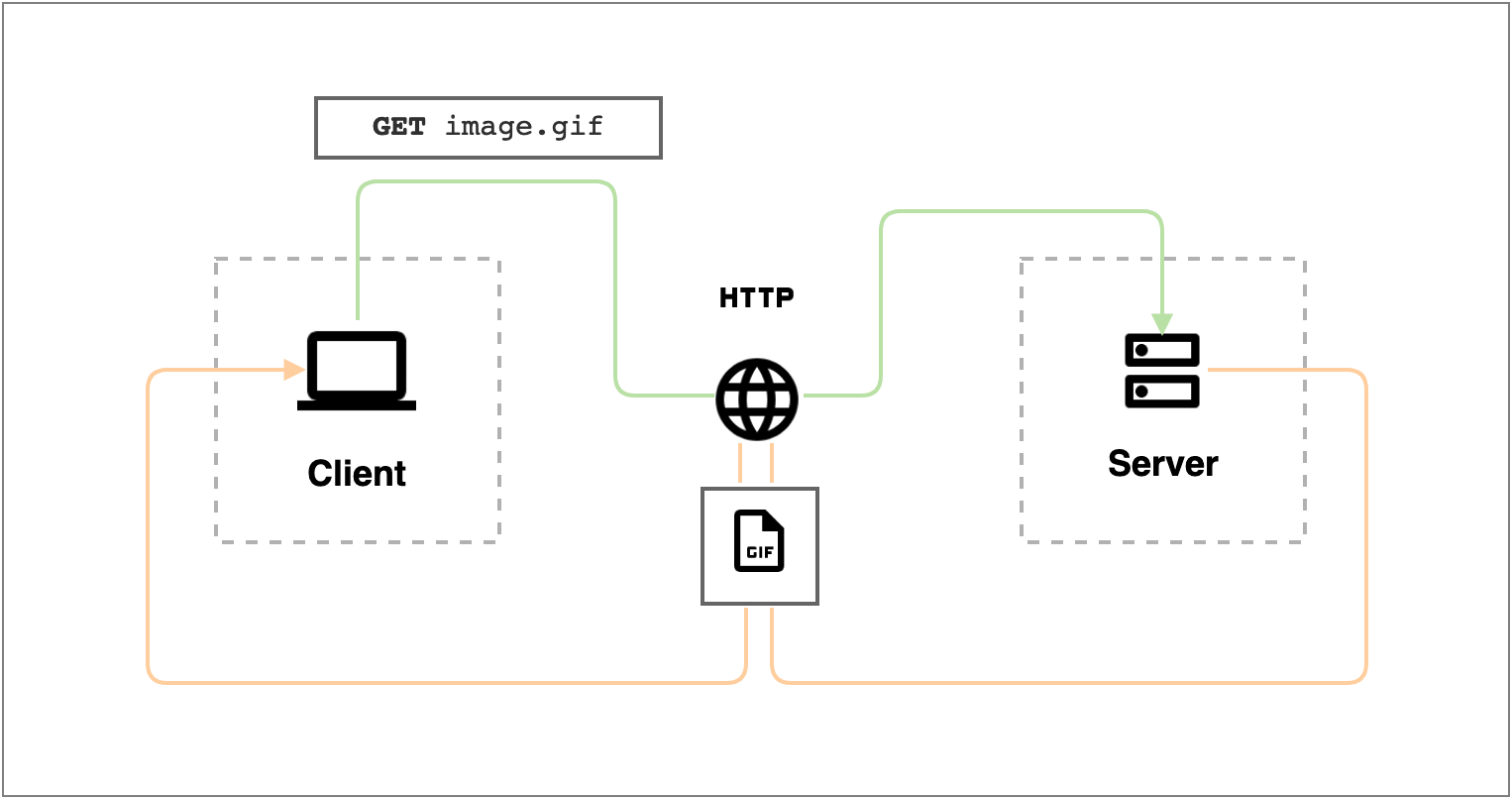
In this diagram, the greenish line shows the menstruum of the request from the client to the server over HTTP. The orange line shows the flow of the response from the server back to the customer.
Though the diagram indicates the communication flow, it does not explicitly evidence what the request from the customer looks like or what the response from the server looks like.
Here is what the response from the server could possibly look like:
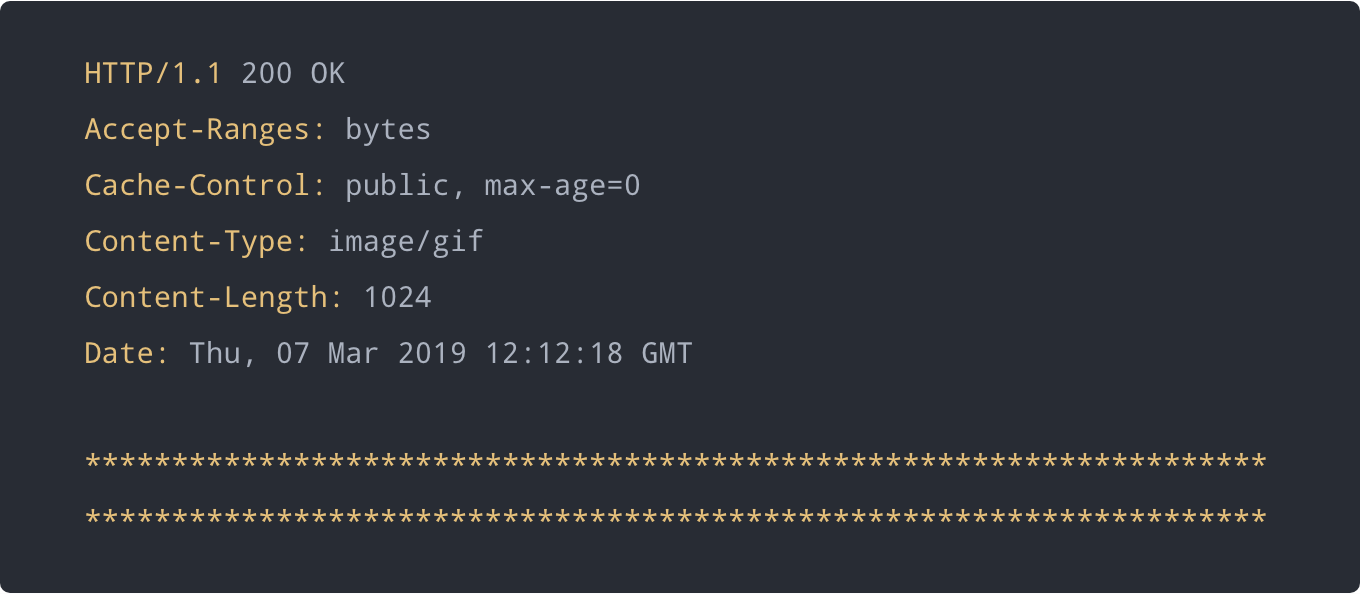
In this response, the server simply serves the raw content of the resource (represented with the asterisks —*) which will exist received by the client.
The response also contains some headers that requite the customer some information nigh the nature of the content information technology receives — in this example response, theContent-Type andContent-Length headers provide that data.
When the client (spider web browser in this case) receives this HTTP response, it merely displays or renders the GIF image — which is not the desired behavior.The desired behavior is that the image should be downloaded non displayed.

Enforcing file download
To inform the client that the content of the resource is not meant to exist displayed, the server must include an additional header in the response. TheContent-Disposition header is the correct header for specifying this kind of data.
The Content-Disposition header was originally intended for mail user-agents — since emails are multipart documents that may contain several file attachments. Withal, it can be interpreted by several HTTP clients including web browsers. This header provides information on thedisposition type anddisposition parameters.
Thedisposition type is usually one of the following:
- inline — The body function is intended to be displayed automatically when the message content is displayed
- zipper — The body part is separate from the main content of the bulletin and should not be displayed automatically except when prompted by the user
Thedisposition parameters are additional parameters that specify information near the torso part or file such as filename, cosmos engagement, modification date, read date, size, etc.
Here is what the HTTP response for the GIF image should expect similar to enforce file download:
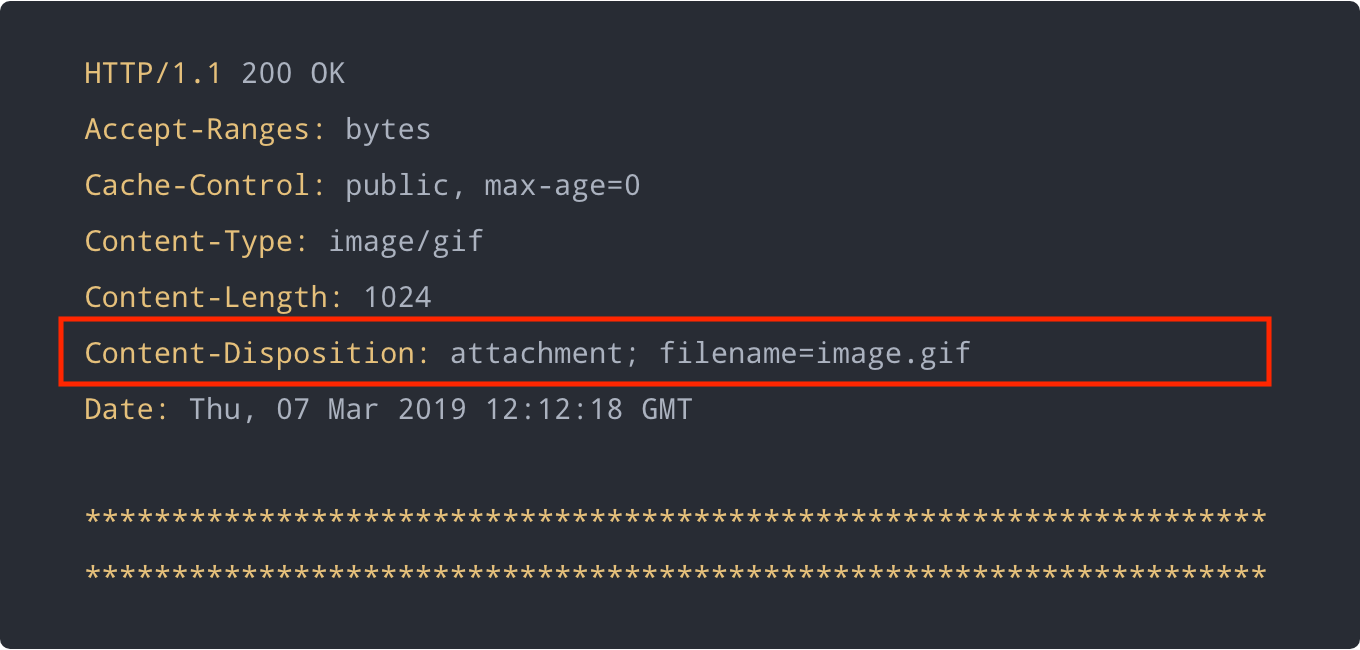
Now the server enforces a download of the GIF image. Almost HTTP clients will prompt the user to download the resource content when they receive a response from a server like the one above.
Click to download in the browser
Let'due south say you have the URL to a downloadable resource. When yous attempt accessing that URL on your web browser, it prompts y'all to download the resource file — whatever the file is.
The scenario described above is non viable in web applications. For web applications, the desired behavior volition exist —downloading a file in response to a user interaction. For example,click to save a photo ordownload a report.
Achieving such a behavior in the browser is possible with HTMLanchor elements (<a></a>). Anchor elements are useful for adding hyperlinks to other resource and documents from an HTML certificate. The URL of the linked resources is specified in the href aspect of the ballast chemical element.
Here is a conventional HTML anchor element linking to a PDF certificate:
The download attribute
In HTML 5, a new download attribute was added to the anchor element. Thedownload attribute is used to inform the browser to download the URL instead of navigating to it — hence a prompt shows up, requesting that the user saves the file.
Thedownload attribute can be given a valid filename as its value. All the same, the user tin can still modify the filename in the save prompt that pops-up.
In that location are afew noteworthy facts about the behavior of the download attribute:
- In compliance with thesame-origin policy, this aspect only works for same-origin URLs. Hence, information technology cannot be used to download resource served from a different origin
- Also HTTP(s) URLs, it besides supports
hulk:anddata:URLs — which makes it very useful for downloading content generated programmatically with JavaScript - For URLs with a HTTP
Content-Dispositionheader that specifies a filename — the header filename has a higher priority than the value of thedownloadattribute
Here is the updated HTML ballast element for downloading the PDF document:

Programmatic content generation
With the advent of HTML5 and new Web APIs, it has become possible to do a lot of complex stuff in the browser using JavaScript without ever having to communicate with a server.
There are now Web APIs that tin be used to programmatically:
- draw and dispense images or video frames on a canvas —Canvas API
- read the contents and properties of files or even generate new information for files —File API
- generate object URLs for binary information —URL API
to mention but a few.
In this department, we will examine how we can programmatically generate content using Spider web APIs on the browser.
Let's consider two common examples .
Example 1 — CSV generation from JSON array
In this case, we will use theFetch API to asynchronously fetch JSON information from a web service and transform the data to form a string ofcomma-separated-values that tin can be written to a CSV file. Hither is a breakdown of what we are well-nigh to do:
- fetch an array collection of JSON objects from an API
- extract selected fields from each item in the assortment
- reformat the extracted data as CSV
Hither is what the CSV generation script could look similar:
office squareImages({ width = one, top = width } = {}) { return width / height === 1; } function collectionToCSV(keys = []) { return (collection = []) => { const headers = keys.map(primal => `"${key}"`).join(','); const extractKeyValues = record => keys.map(primal => `"${record[key]}"`).join(','); render collection.reduce((csv, record) => { return (`${csv}\n${extractKeyValues(record)}`).trim(); }, headers); } } const exportFields = [ 'id', 'writer', 'filename', 'format', 'width', 'height' ]; fetch('https://picsum.photos/list') .then(response => response.json()) .then(data => information.filter(squareImages)) .so(collectionToCSV(exportFields)) .then(panel.log, console.error); Here we are fetching a collection of photos from the Picsum Photos API using the globalfetch() function provided by theFetch API, filtering the collection and converting the collection array to a CSV string. The code snippet just logs the resulting CSV string to the console.
Beginning, we define a squareImages filter office for filtering images in the drove with equal width and height.
Side by side, nosotros define a collectionToCSV college-order part which takes an array of keys and returns a role that takes an array collection of objects and converts it to a CSV string extracting but the specified keys from each object.
Finally, nosotros specify the fields we want to extract from each photograph object in the drove in the exportFields assortment.
Here is what the output could wait like on the console:

Example ii — Image pixel manipulation using the Canvass API
In this example, we will use theCanvass API to dispense the pixels of an image, making information technology appear grayscale. Here is a breakup of what nosotros are about to do:
- set the canvas dimensions based on the prototype
- draw the image on a canvas
- extract and transform the image pixels on the canvas to grayscale
- redraw the grayscale pixels on the canvas
Allow's say we take a markup that looks pretty much like this:
<div id="image-wrapper">
<canvas></sheet>
<img src="https://case.com/imgs/random.jpg” alt="Random Image">
</div>
Here is what the image manipulation script could look similar:
const wrapper = document.getElementById('prototype-wrapper'); const img = wrapper.querySelector('img'); const canvass = wrapper.querySelector('canvass'); img.addEventListener('load', () => { sail.width = img.width; sail.acme = img.height; const ctx = canvas.getContext('2d'); ctx.drawImage(img, 0, 0, width, superlative); const imageData = ctx.getImageData(0, 0, width, height); const data = imageData.data; for (let i = 0, len = information.length; i < len; i += 4) { const avg = (data[i] + information[i + one] + information[i + 2]) / 3; data[i] = avg; // red information[i + one] = avg; // dark-green data[i + 2] = avg; // blue } ctx.putImageData(imageData, 0, 0); }, false); Here is a comparison betwixt an actual image and the respective grayscale canvas epitome.
Blobs and object URLs
Before nosotros proceed to learn how we tin download content generated programmatically in the browser, let's take some time to look at a special kind of object interface called Hulk , which is already been implemented by well-nigh of the major web browsers. You can learn about Blobs here.
Blobs are objects that are used to represent raw immutable data. Blob objects shop information about the blazon and size of data they contain, making them very useful for storing and working file contents on the browser. In fact, theFile object is a special extension of theHulk interface.
Obtaining blobs
Blob objects can be obtained from a couple of sources:
- Created from not-blob information using the
Blobconstructor - Sliced from an already existing blob object using the
Blob.piece()method - Generated from Fetch API responses or other Web API interfaces
Here are some code samples for the same blob object sources:
const data = { proper noun: 'Glad Chinda', country: 'Nigeria', part: 'Web Developer' }; // SOURCE 1: // Creating a blob object from not-blob information using the Hulk constructor const hulk = new Blob([ JSON.stringify(data) ], { blazon: 'application/json' }); const paragraphs = [ 'First paragraph.\r\n', 'Second paragraph.\r\n', 'Third paragraph.' ]; const blob = new Blob(paragraphs, { type: 'text/plainly' }); // SOURCE ii: // Creating a new blob by slicing function of an already existing hulk object const slicedBlob = blob.slice(0, 100); // SOURCE 3: // Generating a blob object from a Spider web API like the Fetch API // Notice that Response.hulk() returns a promise that is fulfilled with a hulk object fetch('https://picsum.photos/id/6/100') .then(response => response.hulk()) .and then(blob => { // use blob here... }); Reading blob content
It is one matter to obtain a blob object and some other thing altogether to work with it. One thing y'all want to be able to do is to read the content of the blob. That sounds like a good opportunity to employ a FileReader object. You tin learn nighFileReader objects here.
AFileReader object provides some very helpful methods for asynchronously reading the content of blob objects or files in different ways. TheFileReaderinterface has pretty good browser support and supports reading blob data equally follows(equally at the time of this writing):
- equally text —
FileReader.readAsText() - as binary cord —
FileReader.readAsBinaryString() - equally base64 data URL —
FileReader.readAsDataURL() - equally assortment buffer—
FileReader.readAsArrayBuffer()
Building on the Fetch API example we had before, nosotros can use aFileReaderobject to read the hulk as follows:
fetch('https://picsum.photos/id/6/240') .and so(response => response.hulk()) .then(blob => { // Create a new FileReader innstance const reader = new FileReader; // Add together a listener to handle successful reading of the blob reader.addEventListener('load', () => { const image = new Prototype; // Fix the src attribute of the image to be the resulting data URL // obtained after reading the content of the blob image.src = reader.effect; document.body.appendChild(image); }); // Start reading the content of the blob // The upshot should exist a base64 data URL reader.readAsDataURL(blob); }); Object URLs
TheURL interface allows for creating special kinds of URLs calledobject URLs, which are used for representing blob objects or files in a very concise format. Hither is what a typical object URL looks like:
blob:https://cdpn.io/de82a84f-35e8-499d-88c7-1a4ed64402eb Creating and releasing object URLs
The URL.createObjectURL() static method makes it possible to create an object URL that represents a blob object or file. Information technology takes a blob object as its argument and returns aDOMString which is the URL representing the passed blob object. Here is what it looks similar:
const url = URL.createObjectURL(hulk); Information technology is of import to note that, this method will always return a new object URL each time it is called, even if it is called with the same hulk object.
Whenever an object URL is created, information technology stays around for the lifetime of the document on which it was created. Usually, the browser will release all object URLs when the document is being unloaded. Withal, it is important that you release object URLs whenever they are no longer needed in order to meliorate operation and minimize retentiveness usage.
The URL.revokeObjectURL() static method can be used to release an object URL. It takes the object URL to exist released every bit its argument. Here is what it looks like:
const url = URL.createObjectURL(blob); URL.revokeObjectURL(url);
Using object URLs
Object URLs can exist used wherever a URL can be supplied programmatically. For example:
- they can exist used to load files that can exist displayed or embedded in the browser such as images, videos, audios, PDFs, etc — for instance, past setting the
srcproperty of anImageelement - they can be used as the
hrefattribute of an<a></a>element, making information technology possible to download content that was extracted or generated programmatically
Downloading generated content
Then far, we take looked at how we can download files that are served from a server and sent to the client over HTTP — which is pretty much thetraditional flow. We have also seen how we can programmatically extract or generate content in the browser using Spider web APIs.
In this section, we will examine how we can download programmatically generate content in the browser, leveraging all we have learned from the beginning of the article and what we already know about blobs and object URLs.
Creating the download link
First, let's say nosotros have ahulk object by some means. We desire to create a helper function that allows us to create a download link (<a></a> element) that can be clicked in order to download the content of the blob, just like a regular file download.
The logic of our helper office tin can be broken down equally follows:
- Create an object URL for the blob object
- Create ananchor element (
<a></a>) - Set the
hrefaspect of the ballast element to the created object URL - Set the
downloadaspect to the filename of the file to be downloaded. This forces the anchor element to trigger a file download when it is clicked - If the link is for a one-off download, release the object URL subsequently the anchor element has been clicked
Here is what an implementation of this helper role will look like:
function downloadBlob(blob, filename) { // Create an object URL for the blob object const url = URL.createObjectURL(blob); // Create a new ballast element const a = document.createElement('a'); // Fix the href and download attributes for the anchor element // You can optionally set other attributes like `title`, etc // Especially, if the anchor element will be attached to the DOM a.href = url; a.download = filename || 'download'; // Click handler that releases the object URL afterwards the element has been clicked // This is required for i-off downloads of the blob content const clickHandler = () => { setTimeout(() => { URL.revokeObjectURL(url); this.removeEventListener('click', clickHandler); }, 150); }; // Add the click upshot listener on the ballast element // Comment out this line if you don't want a one-off download of the blob content a.addEventListener('click', clickHandler, false); // Programmatically trigger a click on the anchor element // Useful if you want the download to happen automatically // Without attaching the anchor chemical element to the DOM // Comment out this line if you don't desire an automatic download of the hulk content a.click(); // Return the ballast chemical element // Useful if you want a reference to the element // in lodge to attach it to the DOM or utilize information technology in some other manner render a; } That was a pretty straightforward implementation of the download link helper function. Notice that the helper triggers a1-off automatic download of the hulk content whenever it is called.
Also notice that the helper office takes a filename as its second argument, which is very useful for setting the default filename for the downloaded file.
The helper role returns a reference to the created ballast chemical element (<a></a>), which is very useful if you lot want to attach information technology to the DOM or utilise information technology in some other style.
Here is a simple case:
// Blob object for the content to be download const hulk = new Blob( [ /* CSV string content here */ ], { type: 'text/csv' } ); // Create a download link for the blob content const downloadLink = downloadBlob(blob, 'records.csv'); // Set the title and classnames of the link downloadLink.title = 'Consign Records as CSV'; downloadLink.classList.add('btn-link', 'download-link'); // Gear up the text content of the download link downloadLink.textContent = 'Export Records'; // Attach the link to the DOM document.trunk.appendChild(downloadLink); Revisiting the examples
Now that we accept our download helper function in place, we can revisit our previous examples and modify them to trigger a download for the generated content. Here we go.
1. CSV generation from JSON array
Nosotros will update the concluding hope.so handler to create a download link for the generated CSV string and automatically click information technology to trigger a file download using thedownloadBlob helper office we created in the previous section.
Hither is what the modification should expect like:
fetch('https://picsum.photos/list') .so(response => response.json()) .then(data => data.filter(squareImages)) .then(collectionToCSV(exportFields)) .then(csv => { const hulk = new Blob([csv], { type: 'text/csv' }); downloadBlob(blob, 'photos.csv'); }) .catch(console.error); Here we have updated the final hope .so handler every bit follows:
- create a new blob object for the CSV string, also setting the correct type using:
{ type: 'text/csv' } - call the
downloadBlobhelper part to trigger an automated download for the CSV file, specifying the default filename as"photos.csv" - move the promise rejection handler to a split up
.catch()cake:
.take hold of(console.mistake) Here is a working and more than avant-garde instance of this application on Codepen :
See the Pen
JSON Collection to CSV by Glad Chinda (@gladchinda)
on CodePen.
two. Paradigm pixel manipulation
We will add some lawmaking to the end of theload upshot listener of theimgobject, to allow u.s.a.:
- create a blob object for the grayscale epitome in the
sailusing theCanvas.toBlob()method - and and then create a download link for the blob object using our
downloadBlobhelper function from before - and finally, suspend the download link to the DOM
Here is what the update should look like:
img.addEventListener('load', () => { /* ... some code accept been truncated here ... */ ctx.putImageData(imageData, 0, 0); // Sail.toBlob() creates a blob object representing the image contained in the sail // It takes a callback function as its statement whose first parameter is the canvas.toBlob(blob => { // Create a download link for the hulk object // containing the grayscale image const downloadLink = downloadBlob(blob); // Set the championship and classnames of the link downloadLink.title = 'Download Grayscale Photograph'; downloadLink.classList.add('btn-link', 'download-link'); // Fix the visible text content of the download link downloadLink.textContent = 'Download Grayscale'; // Attach the link to the DOM certificate.body.appendChild(downloadLink); }); }, imitation); Here is a working example of this application onCodepen :
See the Pen
Image Pixel Manipulation — Grayscale by Glad Chinda (@gladchinda)
on CodePen.
Conclusion
Nosotros've finally come to the end of this tutorial. While there could exist a lot to pick from this tutorial, it is glaring that Spider web APIs take a lot to offer as regards edifice powerful apps for the browser. Don't hesitate to be experimental and audacious.
Thanks for making out time to read this article. If you lot found this commodity insightful, feel free to give some rounds of applause if yous don't mind — as that will help other people detect it hands on Medium.
DOWNLOAD HERE
Posted by: pittmanpooked1975.blogspot.com


0 Komentar
Post a Comment